

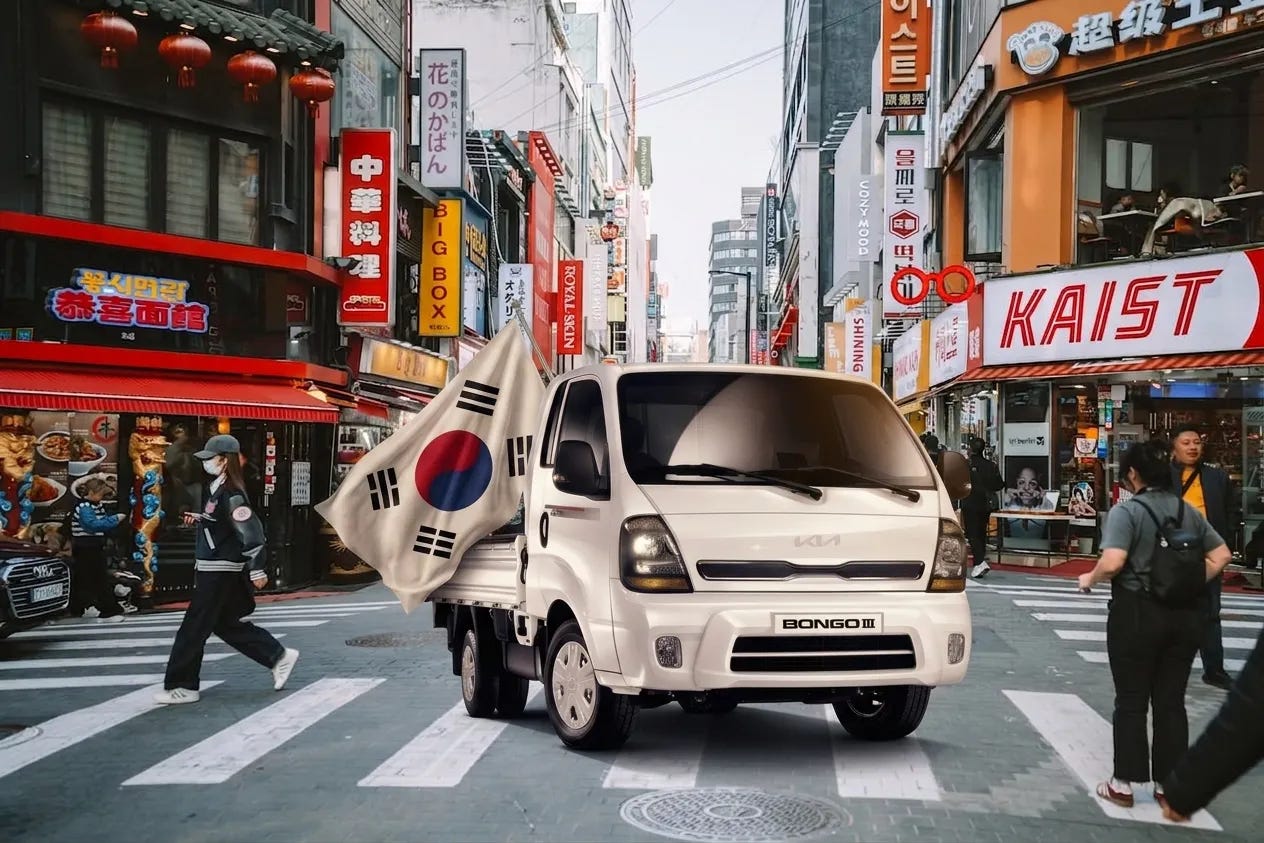
I believe this Korean company deserves a space in my basket of net-nets.
At a P/NCAV ratio of 57%, Motonic trades for almost half the value of its liquid assets, with cash covering 175% of market cap. Recent changes in the controlling family, brought a younger more finance oriented CEO come to power. Within two years of taking the position, she oversaw an increase in the dividend by 70% and published a formal Corporate Value-Up Plan. How shareholder friendly she turns out to be, time will tell, but whilst I wait for further improvements I get paid an ~8% dividend yield. This dividend is fully covered by the operating business and interest earned on cash.
The business itself has maintained profitability at least as far back as 2001, and despite being an automotive parts supplier, profits have been relatively stable. I think, in part, this stems from the fact that they sell mission-critical patented components which make up a single-digit percentage of the vehicle selling price.
They are a Tier-1 OEM parts supplier to the Hyundai/Kia group, which accounts for over 70% of revenue. However, this is not as scary as it sounds. The two have a multi-decade relationship, which included jointly engineering and manufacturing the first mass-produced LPI system in 2003. This was a critical innovation, as a sizeable minority of Korea’s vehicles, especially taxis, run on Liquefied Petroleum Gas (LPG) rather than gasoline. Hyundai and Kia dominate the LPG vehicle market in Korea, with Motonic being their key partner. More recently, they jointly engineered the 4th generation LPID system, with Motonic developing key components. This will power new LPG vehicles. Motonic’s components are deeply integrated into the various vehicle platforms, which take years to develop. Once qualified and integrated, replacing them mid-cycle would require engineering, validation and production changes. I believe these factors make revenue more durable than it appears at first glance.
Demand for LPI and the more modern LPID system is growing as regulations mandate more fuel-efficient vehicles. The classic 1-ton truck, the diesel Kia Bongo, was discontinued due to a ban. It was replaced by an LPG (and EV) version with a next-generation LPID system. Sales of the LPG version have been outstanding. This is a very powerful tailwind as there are 2.2 million of such Kia and Hyundai diesel trucks registered, double the existing LPG national vehicle fleet. These trucks form the backbone of South Korea’s small business, logistics, farming and street-vending industries. I do not think this tailwind is appreciated by the market.
Unlike my normal deep dives, this is a shorter read with less research. However, I do believe I cover the most important factors.
Motonic - 009680
Shares outstanding: 21,633,094
Share Price: ₩10,250
Market Cap: ₩220 billion
Cash & Short Deposits: ₩385 billion
NCAV: ₩387 billion
EV: -165 billion
P/NCAV: 57%
P/B: 0.46x
Dividend Yield: 7.8%
(Once you’re done reading, even if you find the idea bad, I would appreciate you dropping your favourite net-net ideas in the comments.)
Disclaimer: Nothing discussed herein constitutes investment advice; all content is provided for informational and entertainment purposes only. This publication may contain inaccuracies. I am not a qualified financial advisor and reserve the right to trade any securities mentioned at any time without prior notification. Always conduct your own due diligence and consult a qualified financial professional before making investment decisions.
The Business
Motonic is a Tier 1 OEM supplier for the Hyundai Group, which as a whole accounts for over 70% of revenue. The relationship they have with Hyundai Group is arguably one of the most important parts of the thesis. Therefore, I will focus a lot on it.
Motonic’s core competency is fuel systems, specifically LPI (3rd generation) and LPDI (4th generation) systems which account for over 50% of revenue and are sold domestically. These were developed and manufactured together with Hyundai which I will provide evidence for later on in this section.
Additionally, they make electrical components and powertrain systems. I do not focus on them as much in this writeup, but worth noting that sales have been very stable in the last few years. In these two segments, more sales come from cars destined for export, thus recent tariff uncertainty is a headwind. Just something to keep in mind.
History
Montonic was established 1974, initially manufacturing basic carburetors and die-cast metal parts for early Korean cars. In 2002, they rebranded as Motonic Corp. That rebranding coincided with their transition into a development partner and supplier for Hyundai’s liquid LPG program. In 2003, Motonic became the first company in the world to successfully mass-produce a complete LPI System for an automaker’s assembly line. This underscores the fact that Motonic is not a simple manufacturer who Hyundai outsourced production to.
So what is an LPG and am LPI System?
LPG, or liquefied petroleum gas, is a fuel made primarily from propane and butane. It is stored under pressure as a liquid but vaporises when released, allowing it to be used in an internal-combustion engine. Compared with gasoline and diesel, LPG generally produces fewer local air pollutants and can be less expensive, although it has lower energy density and requires specialised fuel-storage and delivery systems.
An LPI, or Liquid Phase Injection, system is a fuel-delivery system for LPG vehicles. Unlike older LPG systems that convert the fuel into vapour before it reaches the engine, LPI injects LPG in liquid form into the intake system.
More recently, the technology has evolved into LPDI, or Liquid Petroleum Direct Injection. Instead of injecting liquid LPG into the intake port, LPDI injects it directly into the combustion chamber. The objective is to improve efficiency and bring LPG closer to the performance characteristics of modern gasoline direct-injection systems.
Korea and Liquefied Petroleum Gas (LPG) Cars
Since the 2000s South Korea has had a commercial fleet of LPG vehicles, mainly taxis and rental cars, in no small part due to Hyundai’s and Motonics commercialisation of the LPI system. Due to a ban on private use, these vehicles were never truly mass adopted. However, Korea’s particle pollution problem forced the government to lift this ban in 2019.
According to data from Korea’s LPG Association the national LPG fleet peaked at around 2.5 million cars in 2010 and has declined to 1.8 million voiceless in 2023. However, for the first time in 14 years this decline has reversed due to the ban on registering new diesel 1-ton trucks. Because these light commercial vehicles spend long hours idling and stop-and-starting in high-density residential zones, the government targeted them to combat urban fine dust and micro-particle pollution. One of the key advantages of LPG cars is that they are much more eco-friendly because they release just a fraction of particulate matter compared to gas-guzzling counterparts.
The 1-ton truck is the workhorse of Korean small business, including logistics and farming. There are around 2.2 million of these Hyundai Porter and Kia Bongo diesel trucks registered [2]. The total install base is twice the existing LPG vehicle fleet.
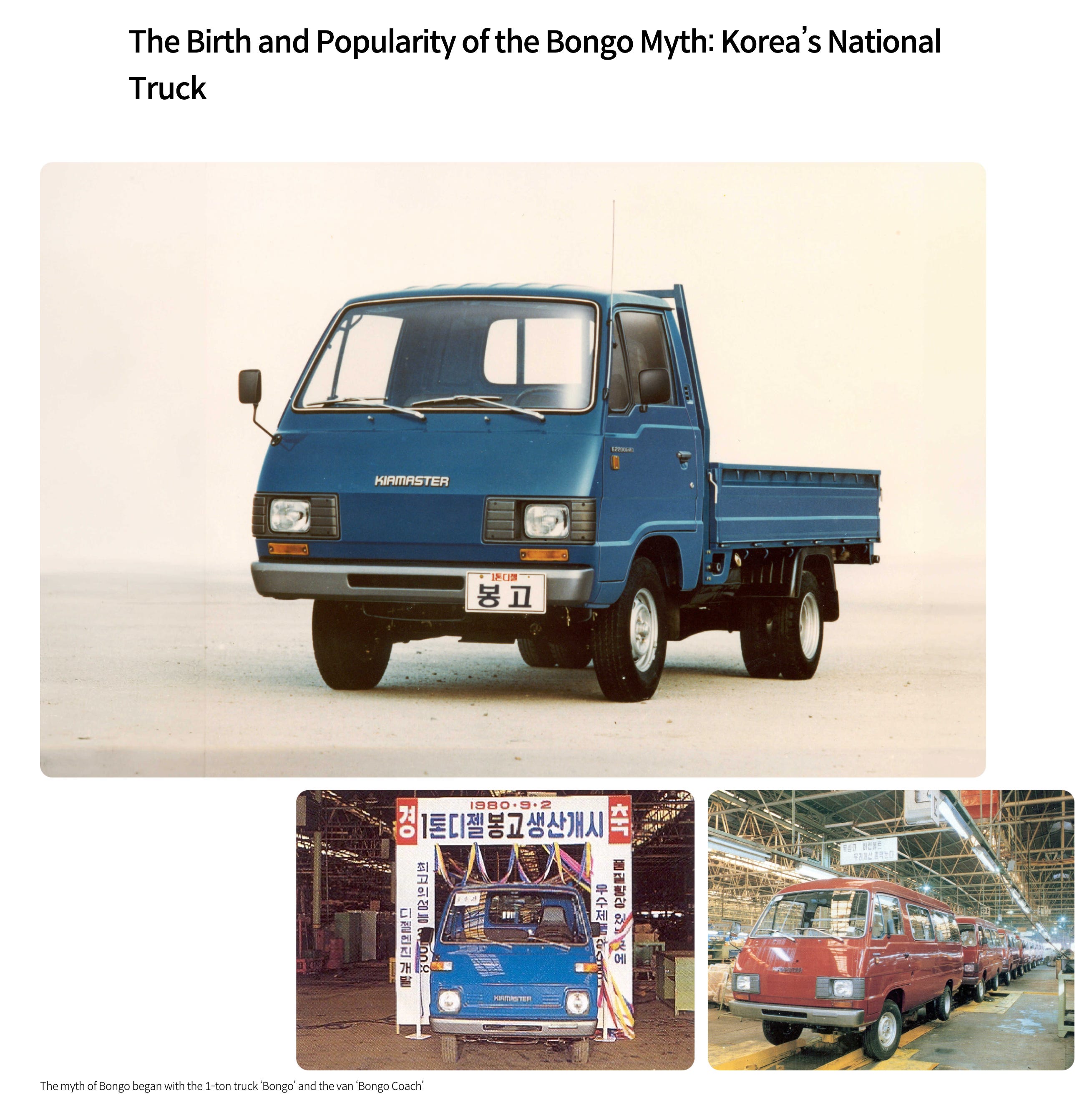
Due to the ban Hyundai has now discontinued the manufacture of diesel trucks, making LPG and EV versions of the almost mythical Bongo truck and its sister Porter truck. The LPG version has accounted for 84% of the sales, with total sales exceeding 100,000 units as of January 2025 [3]. The LPG trucks have better range and charge quicker than EV version while being half the price, making the LPG Bongo, unsurprisingly, more popular with small businesses. Furthermore, these vehicles have more horsepower and torque than the previous diesel version. This is in no small part thanks to the 4th generation LPDI engine.
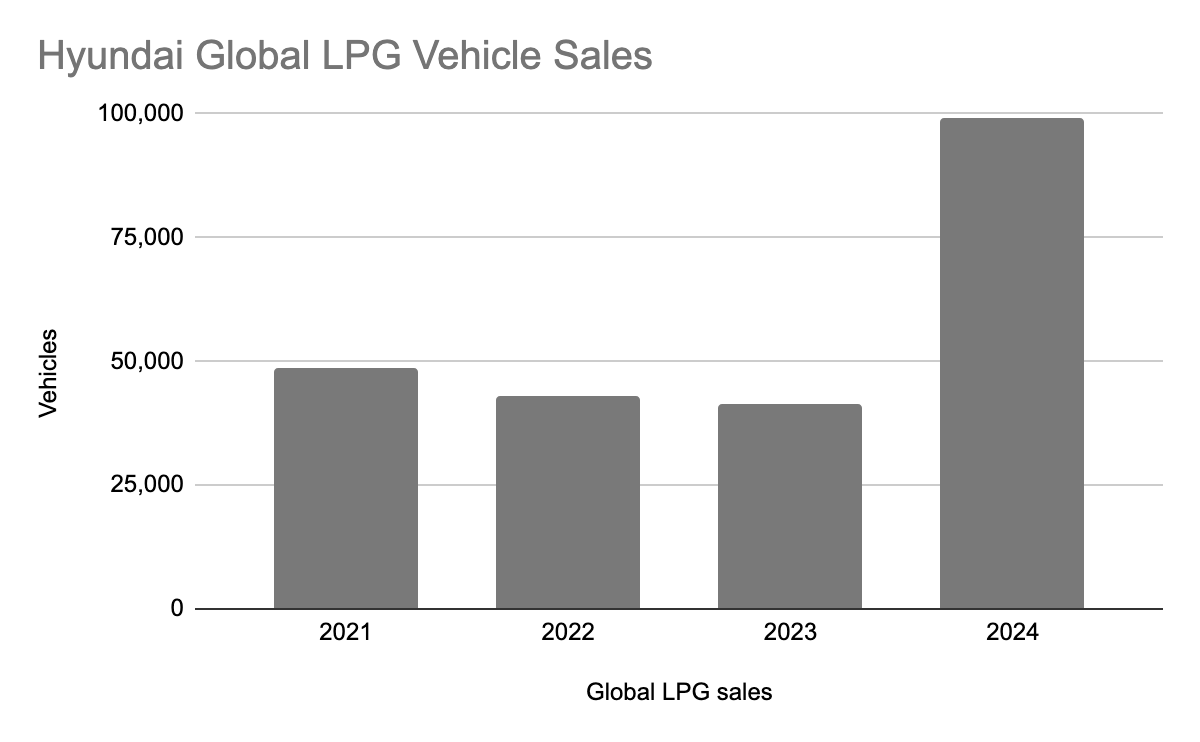
The introduction of the LPG 1-ton truck has resulted in a sales of LPG vehicles more than doubling for Hyundai. In 2024 alone it appears they sold ~60,000 units.
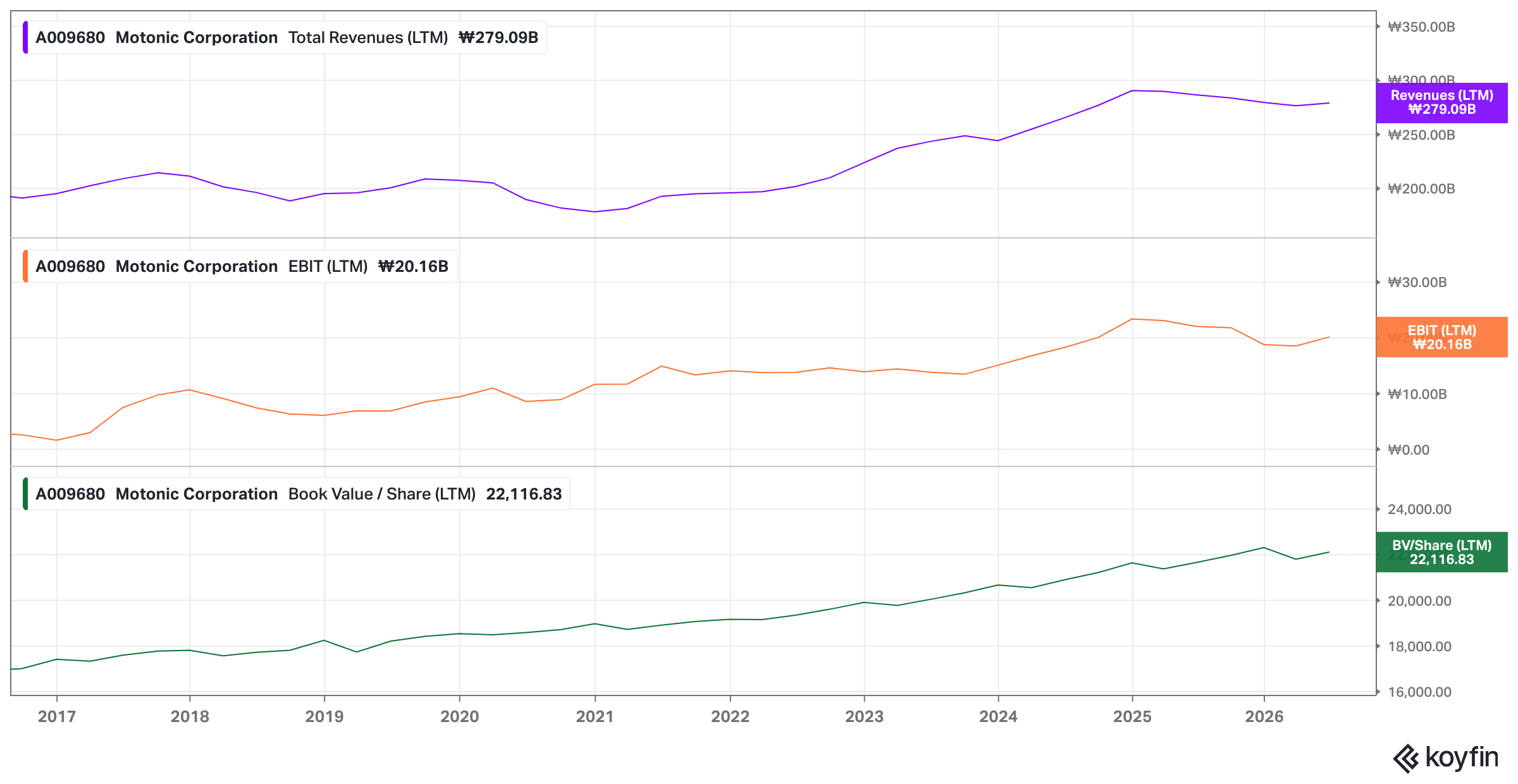
For Motonic, this has coincided in a 50% step up in revenue in fuel system revenue. If we divide the extra 50 billion won in sales by 60,000 and covert to USD we get a price per truck of around 600USD. Less than 4% of a trucks retail price.
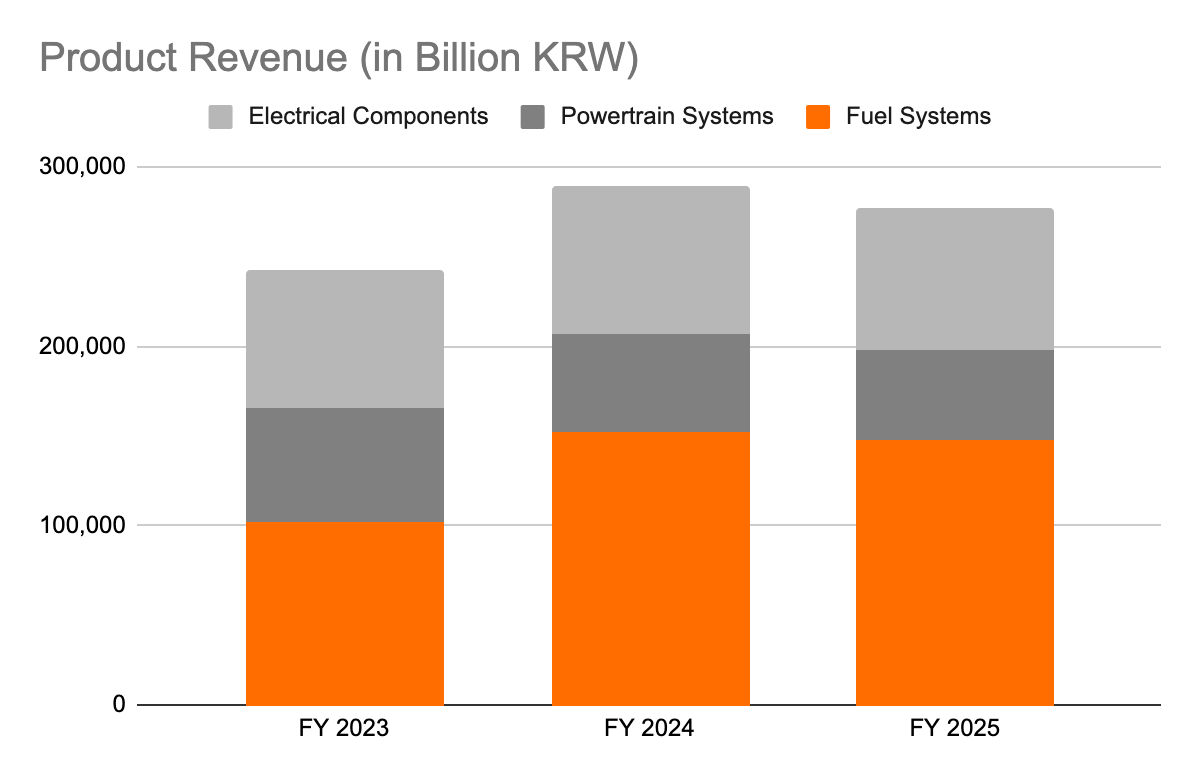
I believe a large part of this increase is sustainable rather than a one off model-launch bump, even if there are some fluctuations in the short term. ~60,000 trucks per year is less than 3% of the total national 1-ton truck vehicle fleet. Therefore, today’s sales are just a fraction of TAM. Eventually, the existing diesel fleet will need replacement. A decade or so from now the first generation LPG trucks will need replacement itself. Therefore, demand for LPG components, including the ones supplied by Motonic, should be structurally higher than in the previous decade.
Finally, it is worth noting that to accelerate the transition away from diesel, the government is offering a grant of up to 9 million won (1 million won for purchase support, plus up to 8 million won in early-scrappage support for owners of diesel trucks). Given that a Bongo costs between 20 and 25 million won, this is a substantial incentive that makes an already strong tailwind even more potent. In addition to the proverbial carrot, the government may pull out the stick and introduce heavier restrictions on diesel trucks in the future. This could serve as a secondary catalyst to bring forward adoption, though, again, the thesis does not depend on it.
LPDI Technology Development
I believe, based on issued patents, published studies and government grants, that the LPDI technology was jointly developed by Hyundai and Motonic over the past 15 years.
The first piece of evidence is a 2012 Korean patent jointly assigned to Hyundai Motor Company and Motonic titled: “LPG Direct Injection System.” The patent describes the architecture of the LPDI system: it covers the high-pressure pump, low-pressure pump, regulator, fuel lines, return system and injector as parts of the LPDI system.
The following picture roughly illustrates the role of the different components and how they fit together.
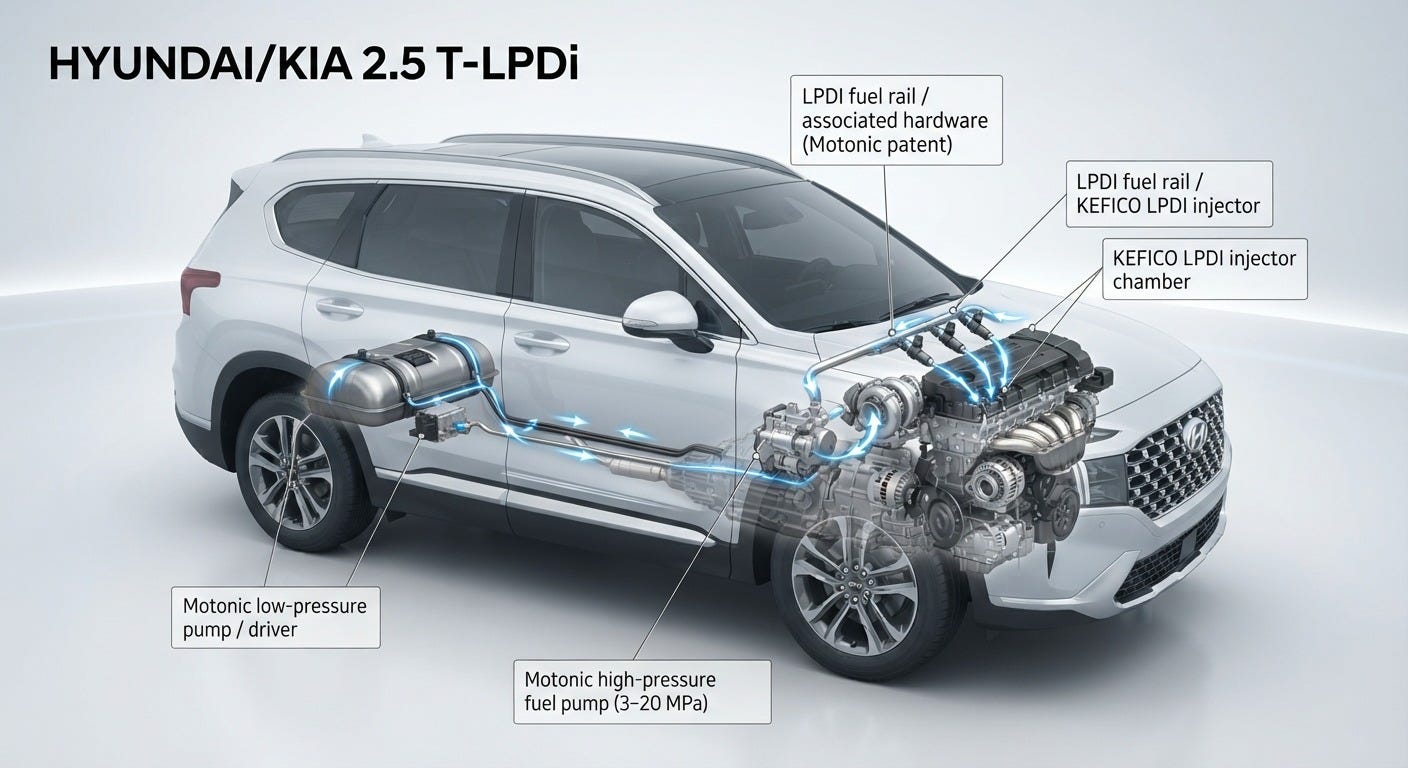
Based on their respective websites, it is clear that Motonic supplies the fuel pumps whilst Hyundai KEFICO, part of Hyundai group, manufactures the direct fuel injector.
There was also a government-funded development programme involving Hyundai and Motonic from 2011 through April 2016. [4]

This is evidence of government funded R&D involving both parties. This grant underscore public policy support for LPG vehicles as a replacement for diesel models. Unsurprisingly, when the government officially banned diesel trucks, Hyundai already had an LPG replacement ready for production.
A 2016 research paper, “A Study on Fuel Control System Optimization for Downsizing Effects and Starting Performance Improvement of LPG Direct Injection Engines” also included Motonic alongside Hyundai [5].
The paper concludes that: “… the optimization of the high-pressure fuel system played a crucial role in enhancing startability under high-temperature soaking conditions.”
This substantiates my overarching argument about Motonic's role in the development process, but it also highlights the importance of the high-pressure fuel system—which is precisely the area in which Motonic supplies key components, including the high-pressure fuel pump. Yes, KEFICO owns the LPDI injector, which at first glance might appear to be a more important component, naturally raising investor caution. However, the injector cannot operate reliably without the fuel-delivery system upstream of it. The key reason is that LPG behaves differently from conventional gasoline. Managing pressure, vapor formation, and fuel leakage becomes very important when the fuel system has to deliver LPG reliably to the engine. This interdependence and complexity should make the system harder to substitute, as replacing a critical fuel-system component requires it to be validated alongside the rest of the system. Patents offer another layer of protection.
Motonic’s patents over the previous decade cover fuel-supply control, LPDI conversion systems and the operation of high-pressure fuel pumps. Importantly, these patents are not all variations on the same pump design; they cover several distinct problems in the LPDI fuel-delivery system, including vapor management, pressure control, pump architecture and fuel-rail connections.
Here is a small sample of the most relevant ones:
KR101987458B1 (2019): High pressure fuel pump and LPDI system. Patent covering a high-pressure fuel pump and LPDI system, including the micro-pipe arrangement intended to address vapor in the high-pressure section.
KR102195859B1 (2020): High pressure fuel pump for LPDI system. This is focused particularly on eliminating vapor lock in the high-pressure section and improving restart performance.
EP3741983B1 (2023): High pressure fuel pump for LPDI system. This European covers the high-pressure fuel-pump architecture, including the piston-cooling concept.
KR102228818B1 (2021): High pressure fuel pump and LPDI system. This is addresses vapor/startup behaviour and the fuel-pressure system.
KR102312717B1 (2021): Fuel rail connection structure for LPDI automobile. This covers the main pipe, injector holders and mounting holders and their connection structure for an LPDI vehicle.
So what we have here is evidence supporting Motonic’s technological expertise and a multi-year research and development partnership with Hyundai, with Motonic progressively building a patent-protected fuel delivery system for the LPDI technology.
Vehicle platforms take years to design, and Motonics patented components are deeply integrated into the various platforms at Hyundai, including the new 1-ton trucks. Once qualified and integrated into a vehicle platform, replacing them mid-cycle would require engineering, validation and production changes. This means that even if Hyundai stopped using Motonic for newer vehicle types, Motonic would likely continue supplying parts for existing platforms. Given the companies’ long relationship and the advantages that come with tight integration, I believe it is unlikely that all new vehicle types across Hyundai will move away from Motonic parts in the near future. Additionally, Motonic’s exposure to Korea's LPG market benefits from its modest scale, which naturally deters new entrants, particularly foreign competitors.
To conclude, I believe all these factors make revenue more durable than it appears at first glance.
Reforms and Capital Allocation
Korea’s Reforms and the Corporate Value Up Program
One of the structural issues in Korea has historically been the concentration of corporate control within family-run Chaebol groups. Chaebols, and their disregard for minorities, is what has driven the phenomenon referred to as the ‘Korean discount’. Even within Korea, companies controlled by Chaebols trade at a higher discount. Korea is now attempting to address some of the bad governance practices through a combination of voluntary value-up measures, stronger shareholder protections and statutory corporate-law reforms.
South Korea's 2024–26 corporate-governance reforms are a combination of the government's Corporate Value-Up Program, and a series of statutory amendments. The 2024 Value-Up Program, inspired by Japan’s governance reforms, was initially designed around voluntary corporate-value-enhancement plans, improved disclosure, shareholder-return incentives, and investor stewardship. The July 2025 Commercial Act amendment materially expanded directors' fiduciary obligations. The act states that directors' duty of loyalty is owed to the company and its shareholders, rather than solely to the company, and the amendment expressly addresses protection of shareholders' common interests. From September 2026, Listed companies with total assets of ₩2 trillion or more are no longer permitted to exclude cumulative voting through their articles of incorporation. Under the revised Commercial Act, listed companies must generally cancel newly acquired treasury shares within one year of acquisition. Further proposals include mandatory offer proposal thresholds and external valuation requirements.
Perhaps most importantly for this thesis is the introduction of high dividend company tax incentives. Eligible dividend income is taxed at progressive national rates of 14% to 30%, compared with a marginal rate of up to 49.5% under comprehensive financial-income taxation. To qualify, a company must not have reduced its dividends relative to FY2024 and must have either a dividend payout ratio of at least 40%, or a payout ratio of at least 25% combined with a year-over-year dividend increase of at least 10%. Crucially, based on current dividend levels, Motonic’s shareholders, including the founding family, are likely eligible for these tax incentives.
Interestingly, Hyundai Group, one of South Korea’s largest chaebols, serves as a useful example for what the 'Value-up' program can achieve in practice. Hyundai Motor has moved toward an unusually explicit shareholder-return framework. At its 2026 CEO Investor Day, the company reaffirmed a total payout ratio of at least 35%, a minimum annual dividend of ₩10,000 per share, and quarterly dividends of ₩2,500 per share [6]. Moreover, it said it would cancel essentially all treasury shares. Other Hyundai subsidiaries have also made explicit total shareholder return targets (Hyundai Mobis, Kia, Hyundai WIA) and ROE targets (Hyundai Glovis, Kia). These changes raise the opportunity cost of maintaining a large underutilised cash balance and may increase pressure on management to demonstrate tangible value creation.
There is no reason to assume Motonic will follow Hyundai, but maybe, just maybe, Motonic’s new CEO will draw some inspiration from their closest commercial partner and largest customer. In fact, there are a few signs that capital allocation may be improving at Motonic too.
New CEO and Capital Allocation
The family collectively controls 12.8 million shares, or roughly 59% of the company. Furthermore, out of 6 seats on the board, only 2 are “independent”. It is therefore worth emphasising that this is not a bet on an outsider coming in and changing capital allocation.
The company has just undergone a third-generation family succession. In June of 2024 Kim Hee-jin inherited 4.95 million shares from her father, Kim Young-bong, making her the largest individual shareholder with her shares accounting for 22.82% of shareholding. In July of 2024 she succeeded her father as CEO. Before becoming CEO, Kim Hee-jin had already spent roughly 11 years inside the company. She worked in financial management from 2013 and then became a financial-management executive in 2022. This give me some hope that Kim Hee-jin understands the economics of the business and the benefits of distributing cash to shareholders.
There is one particularly interesting sign that capital allocation may already be improving at Motonic: the sharp increase in the dividend.
Dividend Payout
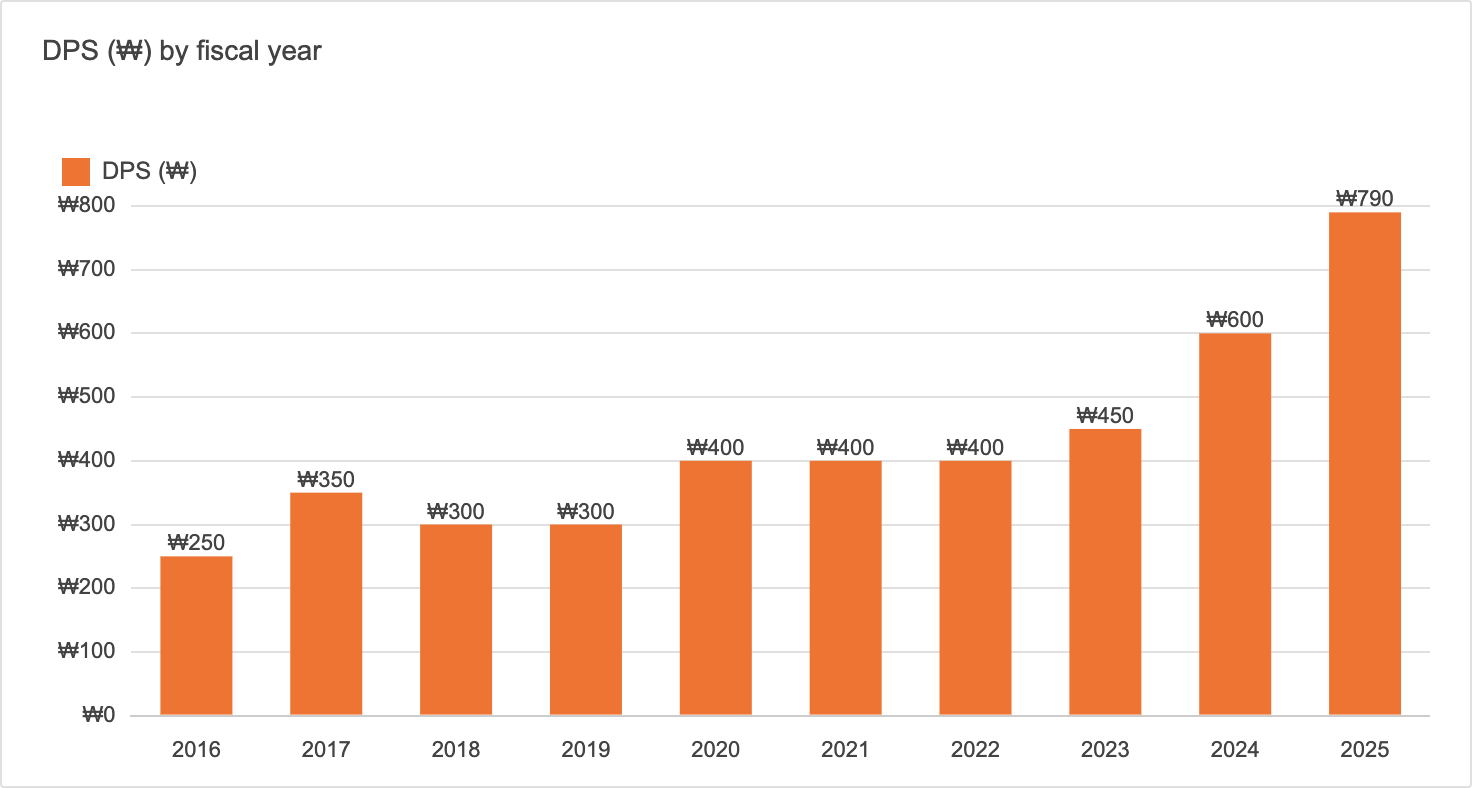
We can see a big step-up: +76% in only two years.
Despite the dividend being covered by current net income, the company states that the ₩790 dividend in the last financial year was funded using reduced capital surplus,. Therefore, under the relevant tax rules, the payment was not subject to dividend-income taxation. This leaves two obvious possibilities.
Was the higher dividend a one-off, after which distributions will return to their previous range?
Or is it evidence that management has begun to recognise that the company does not need such a large cash balance?
Unfortunately, there is no way to tell yet.
The company does not have a formal shareholder-return policy. However, on 24 April 2026, Motonic published its formal Corporate Value-Up Plan. The plan identifies two main goals: finding new growth engines and maintaining stable dividends within distributable profits. Furthermore, as seen in the figure above and despite what the company says formally, it does have a long track record of paying dividends. My hope is that Kim Hee-jin understands that there is no need to have such a large cash pile, let alone expanding it further.
Perhaps out of self-interest as a major shareholder, she will be open to paring down the cash pile further. The new reforms mean even standard dividend payouts qualify for favorable tax treatment, provided Motonic meets the ‘high dividend company’ criteria. To illustrate the impact: in FY2025, Motonic paid ~₩17 billion in total dividends, with Kim Hee-jin receiving around ₩3.92 billion. Under former tax rules, this was subject to a top rate of 49.5% (including the local surcharge). Under the new rules, the effective rate falls to 27.5%. This alters incentives materially. With luck this next generation may be incrementally more shareholder-friendly.
The other stated goal in the Corporate Value-Up Plan is identifying new growth engines and making strategic investments. Following the recent rate hike, South Korea’s interest rate sits at 3%. This does increase the hurdle rate for any acquisitions or major investment plans. However, in my opinion even a mediocre acquisition would be a net positive, provided it does not loose money.
Valuation
Not all net-nets are created equal. The quality of the assets matters.
Most of Motonic’s NCAV value is straight up cash, this means we do not have to make heroic assumptions about the value of inventory or receivables. The company has approximately ₩385 billion of cash against total current assets of roughly ₩436 billion. With a market cap of around ₩220 billion, cash alone is equivalent to roughly 175% of the company’s market value. In other words, the market is valuing the operating business and all other assets at a negative amount after accounting for the company’s cash position.
Lets look at earnings now. Net income consists of two sources: operating business profit and the interest earned on cash.
There is not much to say about the cash, as the thesis assumes it will be distributed or re-invested. The interest income has become increasingly meaningful as Korean interest rates have risen. The Bank of Korea raised its base rate from 2.75% to 3.00% on August 27th, providing an additional earnings tailwind for this financial year.
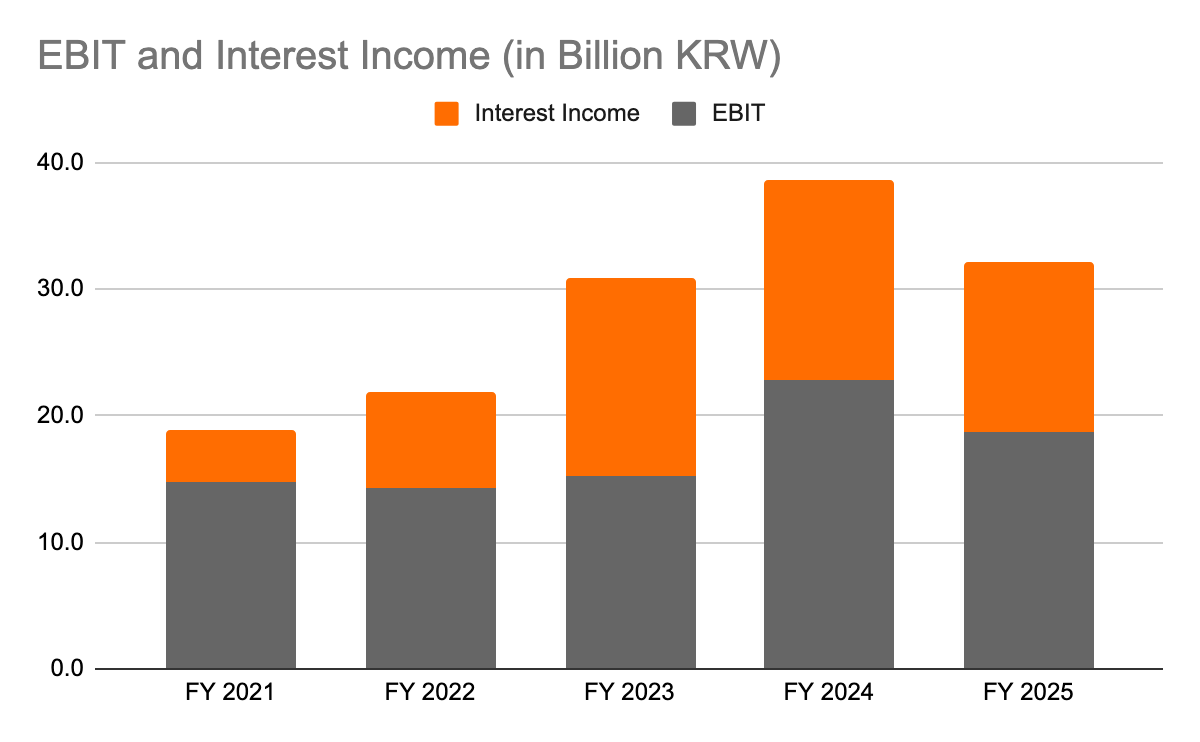

Although operating profit has pulled back from its peak of ~₩23 billion, I expect it to settle in the ₩15–18 billion range, supported by tailwinds in the 1-ton LPG truck segment.
If we assume approximately ₩120 billion of capital is actually required to operate the business after stripping out excess cash, normalised operating profit of ₩15–18 billion implies a rough return on operating capital of approximately 12.5–15%. I do not think a manufacturing business generating a double-digit return on its operating capital deserves to be valued as though the operating business were worthless.
If we apply a multiple of 8x on operating (non-interest) earnings this values the operating business at ₩120–144 billion.
The resulting valuation can be thought of as:
Operating business: ₩120–144bn
Cash: ~₩385bn
Total equity value: ~₩505–529bn
In such a scenario, where cash is fully recognised, the upside to the current market cap of ₩220 billion becomes 130%–140%.
Perhaps more interestingly, the downside case requires even less. If the market eventually recognised only the company’s cash balance and assigned zero value to the operating business, ₩385 billion of cash versus a ₩220 billion market capitalization implies approximately 75% upside. Another way to look at this, is that at the current valuation the market is assigning value to less than 25% of Motonic’s cash pile. Clearly, the market believes the cash is out of reach to non-family shareholders.
This is why I think the central valuation question is not whether Motonic is a wonderful business. It is whether the market will eventually give meaningful value to cash that currently receives little or no value.
The catalyst is also relatively clear.
If dividends continue at the elevated level, the cash balance will gradually become more tangible to shareholders because it will be converted from a balance-sheet number into actual distributions.
Further share buybacks could also produce a meaningful re-rating, although I consider these less likely than continued dividends. The current high dividend yield is itself be evidence that the market does not trust the durability of the payout or perhaps even the durability of earnings. The investment thesis is that both concerns may prove too pessimistic.
Conclusion
Essentially, the market is saying: “Yes, the company has the cash, but we don't believe management will distribute it, and we don't believe current earnings are sustainable.”
However, in my opinion, the LPG transition makes earnings more durable than the market expects, while the new generation of management and Korean governance reforms increase the probability that excess cash eventually reaches shareholders.
The thesis can therefore be summarised quite simply:
Cheap cash. A profitable operating business. A structural 1-ton truck LPG tailwind. Improving capital allocation. And a changing Korean governance environment.
Obviously, basket size position only.
Disclaimer: Nothing discussed herein constitutes investment advice; all content is provided for informational and entertainment purposes only. This publication may contain inaccuracies. I am not a qualified financial advisor and reserve the right to trade any securities mentioned at any time without prior notification. Always conduct your own due diligence and consult a qualified financial professional before making investment decisions.
Appendix
Sources
[1] Hyundai Motor Group. “Kia Bongo: A Steadfast Partner for Small Business Owners in South Korea.” https://www.hyundaimotorgroup.com/en/story/CONT0000000000138884
[2] Korea Commercial Vehicle Information. “Diesel Era Ends, Porter·Bongo Enter Electric/LPG Era” [디젤 시대 끝, 포터·봉고 전기·LPG 시대로]. Citing Kaizuyu Data Research Institute and Ministry of Land, Infrastructure and Transport registration data. https://www.cvinfo.com/news/articleView.html?idxno=26237.
[3] Korea LPG Association, “‘LPG 1-ton Truck’ Capturing Performance and Convenience, Gaining Popularity in Rural Areas.”
https://www.klpg.or.kr/html/dh_board/views/5134
[4] E1 Corporation. "Investment Prospectus: 37-1 and 37-2 Bearer Coupon-Bearing Unsecured Corporate Bonds" [투 자 설 명 서]. September 9, 2021. KRX KIND. https://kind.krx.co.kr/external/2021/09/09/000043/20210909000045/10601.htm.
[5] “A Study on Fuel Control System Optimization for Downsizing Effects and Starting Performance Improvement of LPG Direct Injection Engines,” DBpia.
https://www.dbpia.co.kr/journal/articleDetail?nodeId=NODE07041108
[6] Hyundai Motor Company Charts Profit-Driven Growth Roadmap at 2026 CEO Investor Day. https://www.hyundaimotorgroup.com/en/news/hyundai-motor-company-charts-profit-driven-growth-roadmap-at-2026-ceo-investor-day
Patents
KR101987458B1 (2019) — High pressure fuel pump and LPDI system
Patent covering a high-pressure fuel pump and LPDI system, including the micro-pipe arrangement intended to address vapor in the high-pressure section.
KR102195859B1 (2020) — High pressure fuel pump for LPDI system
Another Motonic LPDI-specific high-pressure-pump patent, focused particularly on eliminating vapor lock in the high-pressure section and improving restart performance.
EP3741983B1 (2023) — High pressure fuel pump
European patent covering the high-pressure fuel-pump architecture, including the piston-cooling concept.
KR102228818B1 (2021) — High pressure fuel pump and LPDI system
Another distinct Motonic LPDI high-pressure-pump patent addressing vapor/startup behaviour and the fuel-pressure system.
KR102312717B1 (2021) — Fuel rail connection structure for LPDI automobile
Fuel-rail patent covering the main pipe, injector holders and mounting holders, together with their connection structure for an LPDI vehicle.
This is fantastic - thank you
great write-up!!!